Trump to become first foreign leader to dine in Forbidden City since founding of modern China

Donald Trump will receive an honor in Beijing not granted to any US President since the founding of the People's Republic of China....

China rolls out the red carpet to Trumps

President Xi escorts visiting American leader to the Forbidden City, business deals worth $9 bn signed.

Tweeting in 280 Characters? Now You Can Do It, Too

Most tweets will now fit 280 characters, up from 140. The new limit will roll out to Twitter users in almost all 40 languages Twitter supports.

Billionaire Builds and Donates World’s Largest Yacht to Clean Up Ocean Platic Trash

Kjell Inge Røkke announced recently his plan to donate most of his multi-billion dollar fortune toward building the Research Expedition Vessel (REV). REV, a future mega-yacht, will be able to vacuum up 5 tons of plastic per day from the ocean and melt it down.

President Donald Trump's noteworthy tweets

President Donald Trump uses Twitter to break news, share his views and feud with critics and celebrities....

Showing posts with label USA. Show all posts

Friday, 17 November 2017

Images suggest North Korea 'aggressive' work on ballistic missile submarine: US Institute

Satellite images taken this month of a North Korean naval shipyard indicate Pyongyang is pursuing an "aggressive schedule" to build its first operational ballistic missile submarine, a US institute reported on Thursday.

Washington-based 38 North, a North Korea monitoring project, cited images taken on Nov 5 showing activity at North Korea's Sinpo South Shipyard.


North Korean leader Kim Jong Un visits a factory in this undated picture provided by KCNA in Pyongyang. Photo: Reuters

"The presence of what appear to be sections of a submarine's pressure hull in the yards suggests construction of a new submarine, possibly the SINPO-C ballistic missile submarine - the follow-on to the current SINPO-class experimental ballistic missile submarine," 38 North said in a report.

The report said that throughout 2017 there had been continued movement of parts and components into and out of two parts yards adjacent to the constructions halls in the center of the shipyard.

It said the Nov 5 images showed two large circular objects that could be sections of a submarine's pressure hull. It said these appeared larger than those for North Korea's ROMEO-class attack submarine.

Images of a test stand indicated continued testing of a mechanism for ejection launch of missiles from a submarine. However, the report said no activity could be seen suggesting preparations for a new test of a submarine-launched missile.

North Korea has been working to develop a nuclear-tipped missile capable of reaching the United States, sparking a major international crisis in which US President Donald Trump has said that all options are under consideration, including military ones.

North Korea is also thought to be working on a solid-fuel missile for submarine launches.

Last month, The Diplomat magazine quoted a US government source as saying US military intelligence had detected a new diesel-electric submarine under construction at Sinpo and dubbed it the Sinpo-C. It said the submarine was likely a larger successor to North Korea's single experimental ballistic missile submarine.

North Korea has conducted dozens of missile tests this year and its largest and biggest nuclear test on Sept 3. The past two months have seen a relative lull and it has not tested a missile since firing one over Japan on Sept 15.

Another article in The Diplomat last month quoted a US government source as saying that North Korea had tested a new solid fuel engine sometime between Oct 15 and Oct 21. US intelligence officials have declined to comment on this. REUTERS

source::

Downing North Korean Missiles Is Hard?

Concerned that the missile defense system designed to protect American cities is insufficient by itself to deter a North Korean attack, the Trump administration is expanding its strategy to also try to stop Pyongyang’s missiles before they get far from Korean airspace.
A long-range ground-based interceptor missile test at Vandenberg Air Force Base in California. These missiles, designed to strike incoming nuclear weapons, are not foolproof, so the Defense Department is looking to other approaches like cyberattacks and drone strikes. 
U.S. Missile Defense Agency, via Reuters

The new approach, hinted at in an emergency request to Congress last week for $4 billion to deal with North Korea, envisions the stepped-up use of cyberweapons to interfere with the North’s control systems before missiles are launched, as well as drones and fighter jets to shoot them down moments after liftoff. The missile defense network on the West Coast would be expanded for use if everything else fails.
Read More::Soon you will be able to fly in a taxi. NASA, Uber join hands
In interviews, defense officials, along with top scientists and senior members of Congress, described the accelerated effort as a response to the unexpected progress that North Korea has made in developing intercontinental ballistic missiles capable of delivering a nuclear bomb to the continental United States.

“It is an all-out effort,” said Senator Jack Reed of Rhode Island, the top Democrat on the Senate Armed Services Committee, who returned from a lengthy visit to South Korea last month convinced that the United States needed to do far more to counter North Korea. “There is a fast-emerging threat, a diminishing window, and a recognition that we can’t be reliant on one solution.”

Continue reading the main story
For years, that single solution has been the missile batteries in Alaska and California that would target any long-range warheads fired toward the American mainland, trying to shoot them down as they re-enter the atmosphere. Such an approach, known as “hitting a bullet with a bullet,” remains of dubious effectiveness, even after more than $100 billion has been spent on the effort. Antimissile batteries on ships off the Korean coast and in South Korea protect against medium-range missiles, but not those aimed at American cities.

Three Layers of Defense Against North Korean Missiles
Washington is responding to the North Korean nuclear threat with a rush of money to strengthen old antimissile systems and inaugurate new ones. The diagram shows a mix of current and proposed options for defeating the North’s long-range missiles.


1. Before the Launch

  • Attacks on infrastructure
  • Industrial sabotage to cripple missiles
  • Cyber and electronic strikes to interfere with launch and guidance systems
  • Missile strikes on launching pad


2. During the Boost Phase

  • Attacks on rising missiles
  • Fighter jets firing air-to-air missiles
  • Drones firing laser beams
  • Drones firing air-to-air missiles

3. During the Midcourse Phase

  • Attacks on incoming warheads
  • Increasing the number of interceptor rockets to as many as 104 from 44
  • Equipping interceptor rockets with improved kill vehicles that are meant to destroy enemy warheads by force of impact

Read More::New AI system can break away from internet and cloud computing, provide privacy
So the administration plans to pour hundreds of millions of dollars into the two other approaches, both of which are still in the experimental stage. The first involves stepped-up cyberattacks and other sabotage that would interfere with missile launches before they occur — what the Pentagon calls “left of launch.” The second is a new approach to blowing up the missiles in the “boost phase,” when they are slow-moving, highly visible targets.

President Trump has praised the existing missile defense system, insisting last month that it “can knock out a missile in the air 97 percent of the time,” a claim that arms control experts call patently false. In trial runs, conducted under ideal conditions, the interceptors in Alaska and California have failed half of the time. And the Pentagon has warned administration officials that the North will soon have enough long-range missiles to launch volleys of them, including decoys, making the problem far more complex.

That helps explain the rush for new protections.

“They’re looking at everything,” said Thomas Karako, a senior fellow at the Center for Strategic and International Studies in Washington, who recently led two antimissile studies and closely monitors the administration’s planning. “What you’re seeing is a lot more options on the table.”

The $4 billion emergency budget sought by the White House is on top of the $8 billion that the Missile Defense Agency has already been granted for this fiscal year, as well as what other military services and agencies are putting into missile defense. Another $440 million was moved from existing programs to antimissile work two months ago, as the North Korea threat became more serious.

In the emergency request to Congress, and in documents made public by its committees, the precise use of the funds is cloaked in deliberately vague language.

Hundreds of millions of dollars, for example, are allotted for what the documents called “disruption/defeat” efforts. Several officials confirmed that the “disruption” efforts include another, more sophisticated attempt at the kind of cyber and electronic strikes that President Barack Obama ordered in 2014 when he intensified his efforts to cripple North Korea’s missile testing.

Using cyberweapons to disrupt launches is a radical innovation in missile defense in the past three decades. But in the case of North Korea, it is also the most difficult. It requires getting into the missile manufacturing, launch control and guidance systems of a country that makes very limited use of the internet and has few connections to the outside world — most of them through China, and to a lesser degree Russia.

In the operation that began in 2014, a range of cyber and electronic-interference operations were used against the North’s Musudan intermediate-range missiles, in an effort to slow its testing. But that secret effort had mixed results.

The failure rate for the Musudan missile soared to 88 percent, but it was never clear how much of that was due to the cyberattacks and how much to sabotage of the North’s supply chain and its own manufacturing errors. Then Kim Jong-un, the country’s president, ordered a change in design, and the test-launches have been far more successful.

The experience has raised difficult questions about the effectiveness of cyberweapons, despite billions of dollars in investment. “We can dream of a lot of targets to hack,” said Michael Sulmeyer, director of the Cyber Security Project at Harvard and formerly the director for cyberpolicy planning and operations in the office of the defense secretary. “But it can be hard to achieve the effects we want, when we want them.”

Congressional documents also talk of making “additional investments” in “boost-phase missile defense.” The goal of that approach is to hit long-range missiles at their point of greatest vulnerability — while their engines are firing and the vehicles are stressed to the breaking point, and before their warheads are deployed.

Defense Secretary Jim Mattis is also weighing, among other boost-phase plans, formulas that draw on existing technologies and could be deployed quickly.

One idea is having stealth fighters such as the F-22 or the F-35 scramble from nearby bases in South Korea and Japan at the first sign of North Korean launch preparations. The jets would carry conventional air-to-air missiles, which are 12 feet long, and fire them at the North Korean long-range missiles after they are launched. But they would have to fly relatively close to North Korea to do that, increasing the chances of being shot down.

A drawback of boost-phase defense is the short window to use it. Long-range missiles fire their engines for just five minutes or so, in contrast to warheads that zip through space for about 20 minutes before plunging back to earth. And there is the risk of inviting retaliation from North Korea.

“You have to make a decision to fire a weapon into somebody’s territory,” Gen. John E. Hyten of the Air Force, commander of the United States Strategic Command, which controls the American nuclear missile fleet, recently told a Washington group. “And if you’re wrong, or if you miss?”

A boost-phase idea getting much notice would be to have drones patrol high over the Sea of Japan, awaiting a North Korean launch. Remote operators would fire heat-sensing rockets that lock onto the rising missiles.

“It’s a huge advance,” Gerold Yonas, chief scientist for President Ronald Reagan’s “Star Wars” program, said of the drone plan. “It’s one of those things where you hit yourself on the forehead and say, ‘Why didn’t I think of that?’”

Leonard H. Caveny, a main planner of the rocket-firing drones and a former Navy officer who directed science and technology at the Pentagon’s antimissile program from 1985 to 1997, said an accelerated program could produce the weapons in a year or less.

Dr. Caveny’s team is considering use of the Avenger, a drone made by General Atomics that has a wingspan of 76 feet. “This is going to be a game changer,” said Arthur L. Herman, a senior fellow at the Hudson Institute in Washington, who collaborates with Dr. Caveny.

The Pentagon’s Missile Defense Agency is also developing a drone that would fire potent laser beams at rising missiles. But recent plans would have it make its debut no sooner than 2025 — too late to play a role in the current crisis or the Trump presidency.

Even so, the effort has influential backers. In the recent talk, General Hyten of Strategic Command called lasers much better than interceptor rockets because they avoided questions over firing weapons into sovereign territories, especially to knock out missile test-flights.
Read More:: Trump opened the floodgates. Now Democratic women are running for office in record-breaking numbers A potent beam of highly concentrated light, he said, “goes out into space,” avoiding the trespassing issue.

In recent months, Congress has urged Pentagon officials to develop both varieties of drones.

Theodore A. Postol, a professor emeritus of science and national security policy at M.I.T. who has drawn up plans for a missile-firing drone, argued that fleets of such weapons patrolling near the North, threatening to undo its strategic forces, would be extremely intimidating and create new diplomatic leverage.

“We need it now,” he said. “My concern is that we get something out there quickly that will pressure North Korea to negotiate.”


Sourece:

Thursday, 16 November 2017

Russian General Denies He’s Behind the U.S. Election Plot

PHOTO ILLUSTRATION BY SARAH ROGERS/THE DAILY BEAST
The former head of the RISS says he never signed off on supposed plans to subvert American democracy. But that doesn’t make him any less a Cold Warrior.

The Russian Institute for Strategic Studies (RISS) is the Kremlin’s think tank. Managed by former officials of  the Russian Foreign Intelligence Service (SVR), it draws up guidelines for President Vladimir Putin’s foreign policy, and last year it was watching the American elections very closely.
Indeed, according to a Reuters report in April, during the 2016 campaign that took Donald Trump to the White House the RISS produced and distributed around the Russian government two documents: one a framework advising Putin how to swing the 2016 U.S. presidential vote in Trump’s favor, and the other a strategy to discredit the elections if Trump failed.

This week in an exclusive interview The Daily Beast spoke with Lt. Gen. Leonid Reshetnikov, who was in charge of RISS until January 2017—which is to say during the entire period in question last year. He denied the allegations in the Reuters report and gave his own interpretation of what led Russia and the United States to their current state of conflict.

“The American intelligence services are a machine that is always working,  constantly making up anti-Russian cases,” Reshetnikov told The Daily Beast.

Read More::Bill Gates just bought 25,000 acres in Arizona

The general perception is that Moscow is defending itself against U.S. aggression, a view strengthened after brief encounters between Putin and Trump at an Asian economic summit in Vietnam. Those produced an accord about fighting the so-called Islamic State in Syria by largely accepting Russia's strategy and dominance there, but there was no relief from past sanctions against Russia and against Putin’s inner circle, or new ones that are due to kick in.

In August, Trump reluctantly signed a bill that was passed overwhelmingly by Congress imposing heavy sanctions on Iran and North Korea as well as Russia. It effectively ties Trump’s hands, preventing him from waiving any of the measures against Putin without Congressional approval.

“The American intelligence services are a machine that is always working,  constantly making up anti-Russian cases”
— Lt. Gen. Leonid Reshetnikov
Some in Moscow argue that Putin’s advisers in the secret services and the ministry of foreign affairs have grown too “old-fashioned,” perhaps too genteel. (One thinks of suave Sergei Lavrov, the foreign minister.) Others see the failure of Russia’s diplomatic push as simply one more example of the U.S. demonizing Russia for all kinds of ulterior motives.

RISS expert Anna Glazova says that relations between the two countries are worse than during the Cold War between the Soviets and the United States. The RISS expert says that U.S. accusations leveled against Russia are cover for economic competition, which is the real reason to implement sanctions "against our country," as Glazova put it on the RISS website this week.

In 2014, after Russia annexed Crimea, a strategic peninsula that had been part of Ukraine, the Group of 7 economic powers, led by the United States, decided to implement three stages of economic sanctions. The goal was to stop Russia from funding, arming, and supplying weapons to Ukrainian rebels in the east of the country. The first stage limited cooperation with Russia, the second was meant to stop any help with technologies for Russia, and the third, the worst part, was to limit the development of certain sectors of the Russian economy.
Then additional sanctions were imposed by the Obama administration last year to punish Russia for its interference in the American elections. Previously, in 2012, the U.S. imposed sanctions targeting members of Putin’s inner circle believed responsible for massive corruption and, specifically, the death in prison of whistleblowing accountant Sergei Magnitsky.

The RISS analyst, Glazova, did not mention any of the reasons behind the U.S. economic sanctions. Instead, she insisted they are “an attempt to push our energy companies off the world’s market.” And since Russia’s greatest source of income is the sale of oil and natural gas, that would be disastrous, but low energy prices already have been at least as hurtful to Russian prosperity as the sanctions.

It is important to understand this line of defensive thinking at RISS, one of the key institutions advising the Kremlin.

“It is a very influential center,” Sergei Markov, a member of the Public Chamber of Russia’s parliament and an adviser to the presidential administration, told The Daily Beast. “I once passed a recommendation on an important issue to the country’s leadership through RISS and all my suggestions were heard and implemented.”

The Reuters report in April said the RISS gave recommendations to the Kremlin—a game plan—on how to affect the U.S. presidential elections. If true, those policy papers could be a key element for the investigations related to Russian meddling in the U.S. elections that are being conducted by Special Counsel Robert Mueller’s team and committees of the U.S. Congress.

“Curiously, President Trump has been the main voice in the United States casting doubt.”
It should be noted that those investigations are focused on the question of Trump campaign team complicity or conspiracy with Russian operatives, not the question of whether there was Russian interference. Of that there seems to be little doubt. The U.S. intelligence community concluded last year that Russians carried out a massive effort to affect the outcome and credibility of the American elections, and that this was done on Putin’s orders. Those findings were made public in January.

Curiously, President Trump has been the main voice in the United States casting doubt on these conclusions, although it is often difficult to determine what he actually means. As the New York Times reported Saturday, after Trump’s brief meetings with Putin he called accusations of Russian meddling a politically motivated “hit job” that interfered with important cooperation between Moscow and Washington on life-or-death issues.

“Every time [Putin] sees me he says, ‘I didn’t do that,’ and I really believe that when he tells me that, he means it,” Trump said. “I think he is very insulted by it, which is not a good thing for our country.”

The leaders of the intelligence agencies that came to the conclusions about Russian meddling published in January were “political hacks,” he said.

But, as much as Trump might want the core conclusions about Russian efforts to subvert American democracy to have changed, they have not. This, even as evidence mounts that some of his campaign advisors and his relatives, including son Donald Trump Jr. and son-in-law Jared Kushner, were in direct contact with Russian agents or proxies.

On Sunday, pressed for a clarification, Trump said he backed the conclusions of the U.S. intelligence agencies “as currently led, by fine people.” As to whether he believed Putin’s claim there was no Russian interference in the elections, Trump said, “What he believes, he believes.”

The Reuters report in April about the RISS policy papers was not based on the documents themselves, but on interviews with “three current and four former U.S. officials.”

According to the report, the U.S. intelligence services had obtained two documents prepared by the RISS. One of them was “a strategy paper written last June [2016] that circulated at the highest levels of the Russian government but was not addressed to any specific individuals,” according to the report. It advised the Russian leadership to launch a massive propaganda campaign on social media and in the Kremlin-controlled mass media to encourage Americans to vote for Trump, considered a candidate who would be friendlier to Russia than Barack Obama had been or Hillary Clinton would be.

“As President Putin said, is ‘the dog’s barking but the caravan’s walking.’”
— Lt. Gen. Leonid Reshetnikov
The second document drafted in October 2016 warned that Hillary Clinton was most likely going to win the election, so the focus should shift to discrediting Clinton’s legitimacy, raising questions of voter fraud that would undermine her presidency.

Lt. Gen. Reshetnikov, the former head of RISS, dismissed the Reuters report when he talked to The Daily Beast on Monday of this week.

“I was the RISS director until January, and I definitely never signed any of the described papers,” he said. “All documents passed to the very top of the country’s leadership are marked, ‘classified as secret,’ they could not be circulating in public.” Washington was just listening “to some information passed to them by their Moscow spooks,” Reshetnikov said.

He denied having anything to do with the army of trolls agitating for Trump on social media last year.

“It could be that some one or two former RISS employees, freelancers, had written some recommendations to the leadership, which, if they were circulating in public were not very serious,” Reshetnikov said. “Besides, somebody in the U.S. said the recommendations were 30 pages long. I do not remember anything as long as that. We tried to write short notes, since we realized that the management did not have enough time to read what we wrote.”

Before President Putin appointed Reshetnikov as the director of RISS in 2009, the general was the head of the information-analytical department of the SVR and the number one Kremlin adviser on foreign policy. He had been part of the foreign intelligence service since 1976.

Reshetnikov and his colleagues worked on themes for Putin’s key speeches at international events, including the memorable speech at the Munich Security Conference in 2007, when the Russian president criticized Washington’s behavior as the only center of global authority and suggested the world develop a multi-polar system that would allow other centers of economic and political influence to grow stronger.

It was also in 2007 that Putin decided to oblige all independent and foreign-funded NGOs to register as “foreign agents.”

Reshetnikov blamed the current tensions between Russia and United States on Washington. “The Cold War between Russia and the USA that lasted for decades in Soviet times has never ended,” Reshetnikov said. “The main problem is that the USA proclaims itself responsible for the New World Order while, as President Putin said in his speech in Munich, Russia rejects that concept.”

This is fundamental, according to Reshetnikov.  “Especially under Obama, Washington wanted to downgrade Russia to the level of a second-rate regional power.”

“The Cold War between Russia and the USA that lasted for decades in Soviet times has never ended”
— Lt. Gen. Leonid Reshetnikov
But now, “Russia is growing more powerful in its own concept of multipolar world, defending its sovereign spiritual power, while the U.S. suffers from ideological crises,” said Reshetnikov.

He said that the RISS was a powerful institution with at least 200 employees working under his management, focusing on both closed and open sources to analyze the current Cold War situation.

Reshetnikov blamed Washington for constantly offending Russia, for NATO expansion into countries neighboring Russia, for bringing anti-missile systems to Europe, for not cooperating in Syria.

“The American intelligence services are a machine that is always working,  constantly making up anti-Russian cases such as the Magnitsky case or some reason to ban Russian Olympic athletes, but they will not have enough power to keep pressing Russia all over the perimeter,” said the intelligence veteran. In his view, Russia has plenty of reason to look for revenge.

“The war is obvious: the U.S. implemented sanctions against Russia, and put pressure on Europe to back up the neo-Nazi regime in Ukraine, but our response, as President Putin said, is ‘the dog’s barking but the caravan’s walking.’ We’ll proceed with our strategy and that will be our way to give them a blow in their teeth.”

“Russia is growing more powerful ... while the U.S. suffers from ideological crises”
— Lt. Gen. Leonid Reshetnikov
The economic sanctions against Russia would be lifted if the Kremlin decided to withdraw military advisers and equipment from Eastern Ukraine, but there is no sign that’s going to happen.

As Kremlin advisor Markov put it, “I am convinced, that the sanctions will be lifted, as soon as we liberate Odessa and Kharkov from the neo-Nazi Ukrainian regime.”

The former RISS head Reshetnikov says that he has never had any illusions about Donald Trump.

“I always knew that he was not free, that he was very limited in his actions, bound hand and foot," Reshetnikov told The Daily Beast. The Russians had hoped for a very upbeat encounter at the economic summit, but, “Trump has to avoid positive meetings like the one planned in Vietnam because he is half of a president,” said Reshetnikov. “So we need to wait for two to six month and see how this difficult situation develops.”

On that score there is little doubt what at least half of Trump would like to do. Over the weekend he blamed “haters and fools” for thwarting the good relationship he wants to have with Putin, and he didn’t mean Russian haters and fools.
Meanwhile, the Kremlin is contemplating retaliation after the U.S. Department of Justice proclaimed the Kremlin-backed TV network RT, formerly Russia Today “a foreign agent.” Moscow wants to punish the U.S. media working in Russia for turning the U.S. public against it.

Tuesday, 14 November 2017

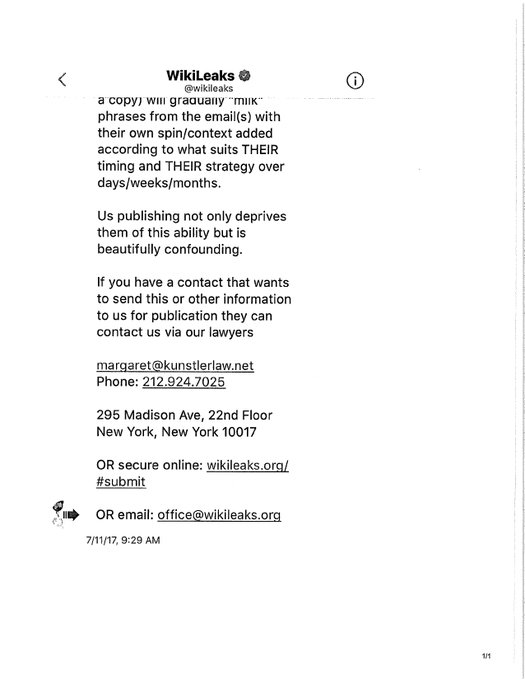
Trump Jr releases private Twitter exchanges with WikiLeaks

Scott Morgan/Patrick McMullan via Getty
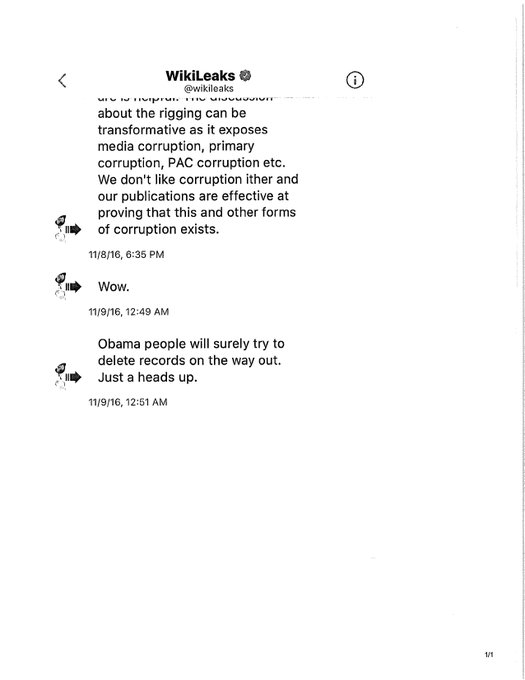
WikiLeaks asked for Donald Trump's tax returns and also suggested he recommend Julian Assange as an ambassador to the US.


Donald Trump's son has released private Twitter messages he exchanged with WikiLeaks in the run-up to the US election.

Donald Trump Jr's response came after they were leaked to The Atlantic website.

The Twitter direct messages began in September 2016 and ran through to July this year.
The vast majority of the communication was one-sided, coming from WikiLeaks, and the President's son only responded three times.

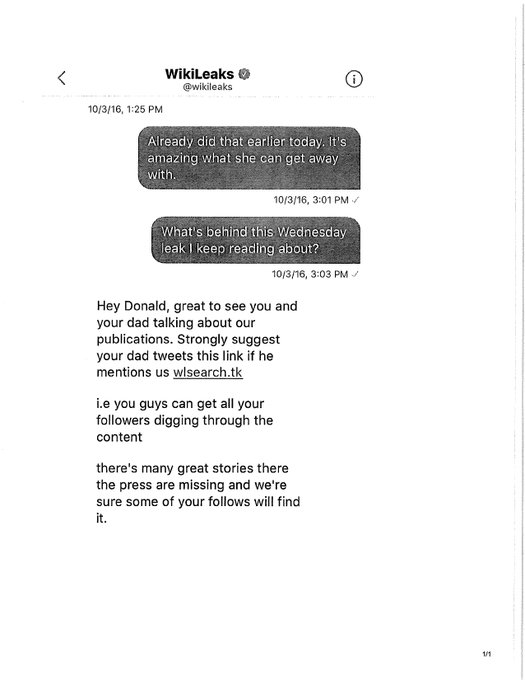
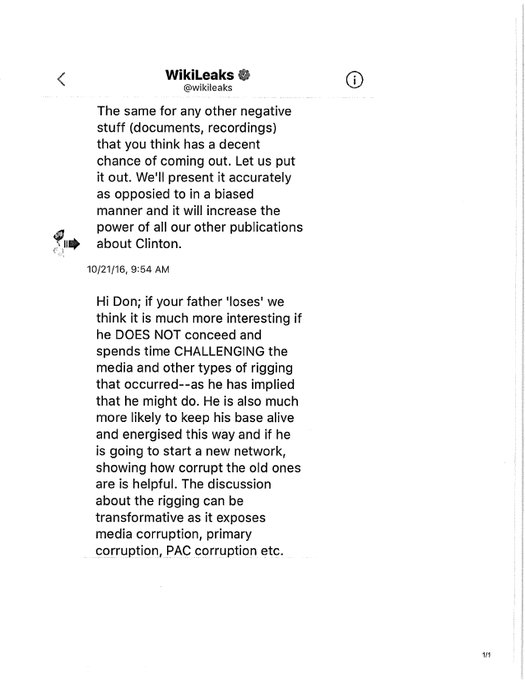
They show the organisation made a series of requests: from asking for comments and suggesting President Trump retweet a link, to suggesting Mr Trump should not concede if he lost the election.

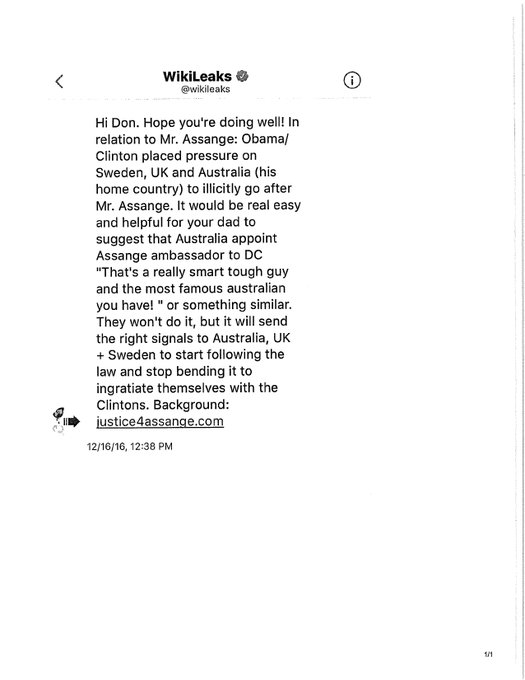
They even encouraged the President-elect to ask Australia to make WikiLeaks' founder, Julian Assange, ambassador to the US.

The message suggested he tell the country: "'That's a really smart tough guy and the most famous Australian you have!' or something similar."

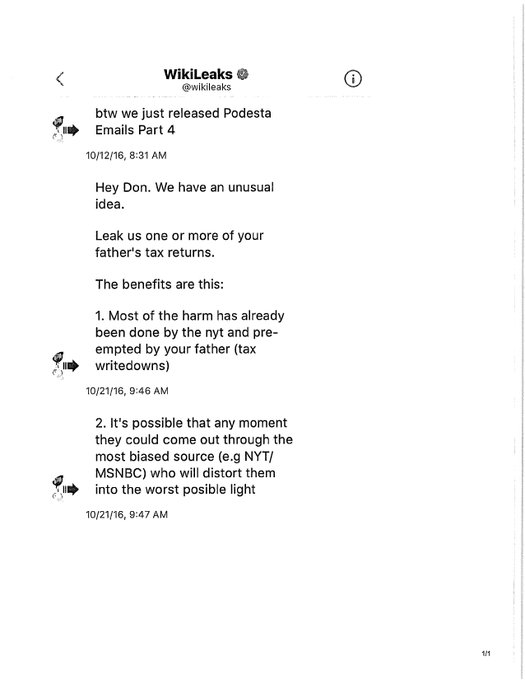
Another request was for Mr Trump Jr to give them his father's tax returns.

The organisation said it had an "unusual idea", asking him: "Leak us one or more of your father's tax returns."

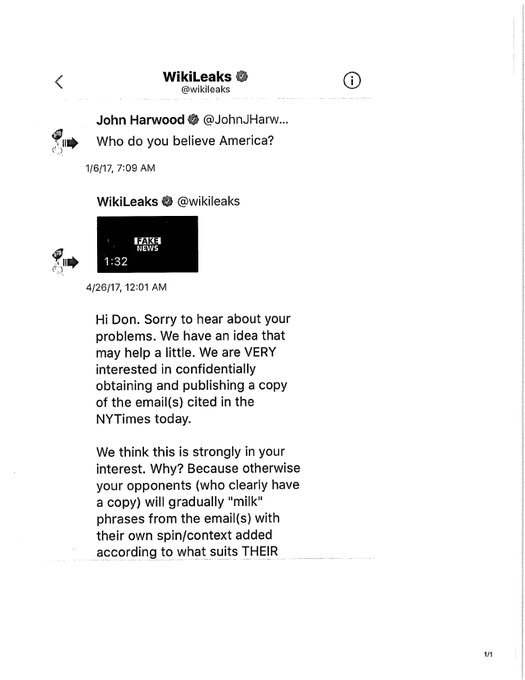
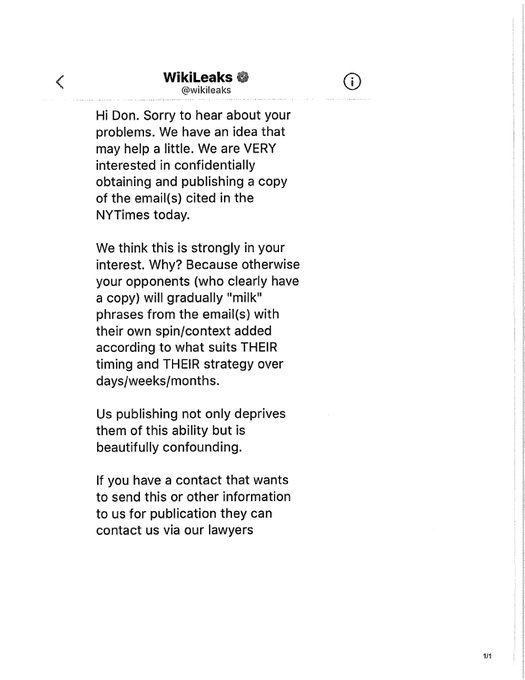
View image on TwitterView image on TwitterView image on TwitterView image on Twitter
Here is the entire chain of messages with @wikileaks (with my whopping 3 responses) which one of the congressional committees has chosen to selectively leak. How ironic! 1/3
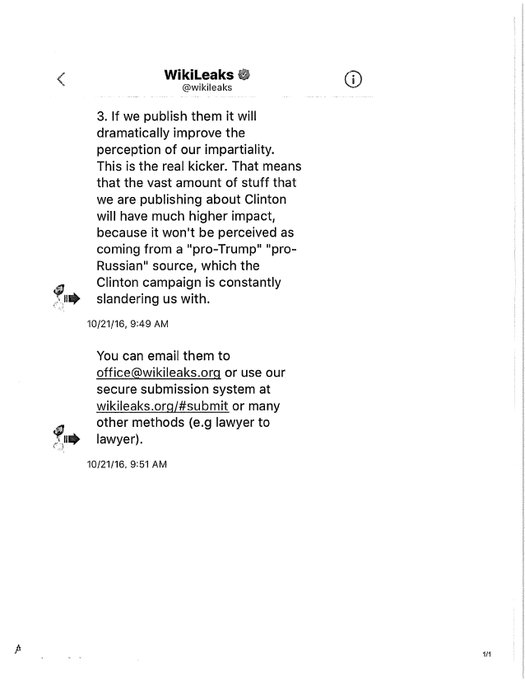
It gave three reasons why it claimed such a disclosure would benefit both the Trump campaign and WikiLeaks.

One of them being: "If we (WikiLeaks) publish them it will dramatically improve the perception of our impartiality."

According to the messages, Mr Trump Jr did not respond.

In response to the leaking of the messages on Monday, Mr Trump Jr released the "entire chain" of messages "with my whopping three responses".

View image on TwitterView image on TwitterView image on Twitter
His responses were agreeing to "ask around" about a political action committee mentioned by WikiLeaks; a comment about Hillary Clinton in which he said "it's amazing what she can get away with".
Read More::Bill Gates just bought 25,000 acres in Arizona to build a new 'smart city' And, in October last year, just before WikiLeaks published emails linked to Mrs Clinton's campaign, asking "What's behind this Wednesday leak I keep reading about?"

The messages had already been handed over by Mr Trump Jr's lawyers to three congressional committees investigating alleged Russian intervention in last year's election, and claims of collusion between the Trump campaign and Russia.

An FBI, CIA and FBI assessment last year concluded that Russian intelligence had given hacked information from the Democratic Party to WikiLeaks.

View image on TwitterView image on TwitterView image on Twitter
WikiLeaks has denied Russia was the source of the emails it released, including those from John Podesta, Mrs Clinton's campaign chairman.

The leaked Twitter exchanges are likely to increase calls for Mt Trump Jr. to testify publicly in front of the various committees.

In a statement, Mr Trump Jr's lawyer, Alan Futerfas, said: "Putting aside the question as to why or by whom such documents, provided to Congress under promises of confidentiality, have been selectively leaked, we can say with confidence that we have no concerns about these documents and any questions raised about them have been easily answered in the appropriate forum."
Donald Trump Jr released the messages with his 'whopping three responses'
Vice President Mike Pence said, via his spokesman, that he was "never aware of anyone associated with the campaign being in contact with Wikileaks".

Adam Schiff, the top Democrat on the House Intelligence Committee, said the situation "demonstrates once again a willingness by the highest levels of the Trump campaign to accept foreign assistance".

Read More::Reddit CEO: Company May Go Public by 2020